

Larch vs Pine vs Spruce: How to Tell UK Conifers Apart
Walk into almost any conifer wood in Britain and you are probably standing among larch, pine or spruce — often all three within a hundred metres of each other. From the car park they can look depressingly similar: dark green, roughly conical, a bit prickly. Close up, they are completely different trees, and the differences are the sort you can check with your hands in under a minute. The secret is not to rely on one clue. Needles, cones, bark and overall shape each tell part of the story, and two or three together will settle the question.
Start With the Needles
Needles are the fastest route in, because you can check them without waiting for a cone or squinting at bark twenty feet up.
Pine needles grow in bundles, joined at the base by a papery sheath. Scots pine usually carries two needles per bundle, sometimes three, short and blue-green, often with a slight twist. Break a bundle open and the sheath is unmistakable — like the wrapper on a tiny bunch of flowers.
Spruce needles grow singly, all the way round the twig, each one sitting on a small woody peg. That peg is the detail worth learning. Pull a spruce needle off and the peg stays behind, so the twig feels rough and knobbly, like a fine rasp. Spruce needles are also four-sided: roll one between finger and thumb and it turns smoothly and evenly. Sitka spruce needles are sharply pointed, blue-green with white bands underneath. Norway spruce needles are shorter, darker and much kinder to the hands.
Larch refuses to play by conifer rules. Its needles sit in soft tufts of twenty or more on short woody spurs, with single needles on the newest growth. Stroke a larch branch and it feels feathery rather than fierce. Bright green in spring, the needles turn amber and gold in autumn, then fall — the whole tree goes bare for winter.
- Bundles with a papery sheath: pine.
- Single needles on rough, pegged twigs: spruce.
- Soft tufts on spurs, gold in autumn: larch.
Pines come in parcels, spruces sit on pegs, larches grow in tufts — and only larches drop their needles.
Read the Cones
Cones are the most reliable single feature, so long as you accept that you may need to come back in autumn.
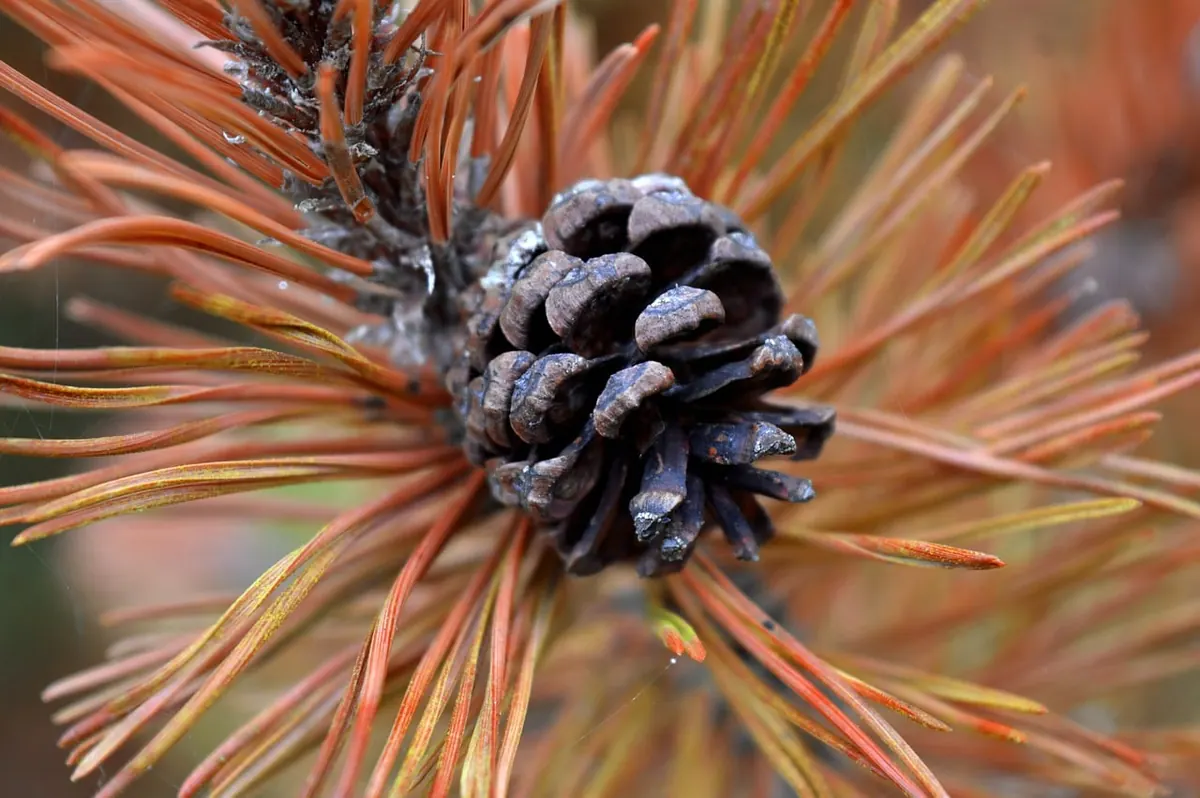
Pine cones are woody, with thick, stiff scales, and they take two years to mature. They sit on the branches — some resting on top, some hanging — and they drop whole rather than breaking up. You will often find opened cones on the ground beneath a pine, spread out like small wooden flowers. Old cones sometimes cling to the branches for years, so a quick look upwards can confirm a pine even in spring.
Spruce cones hang downwards from the branch and fall whole in autumn and winter, regularly carpeting the ground beneath the tree. Norway spruce cones are long and cigar-shaped, roughly the length of your hand; Sitka spruce cones are smaller. Spruce cone scales are thinner and more flexible than a pine's.
Larch cones are small, egg-shaped and only a couple of centimetres long, and they stand upright along the twig rather than hanging. The scales often have small bracts poking out between them, which gives Japanese and hybrid larch cones a slightly fringed look. Crucially, they stay on the tree for several seasons. A bare winter larch covered in little wooden rosettes is one of the easiest identifications in the British countryside.
If the cone sits upright on top of the branch and falls apart on the tree, leaving a bare spike behind, you are looking at a true fir rather than a spruce.
Look at the Bark
Bark is useful once a tree is more than a few years old, and it is a helpful confirmation rather than a first test.
Scots pine has the showiest trunk in the group: orange-red on the upper trunk, flaking away in flat plates that look like pieces of a jigsaw, with darker, heavily fissured bark lower down. Not every pine is so obliging, but orange tones in the crown of a trunk are a strong hint.
Spruce bark is thin, grey-brown and scaly, often with sticky resin blisters on young trunks. It is rarely distinctive enough to identify a tree on its own.
Larch bark is grey-brown and deeply fissured, with the cracks running vertically up the trunk. On older trees it looks weathered and slightly slate-like, and on a Dunkeld larch — the hybrid widely planted in British forestry — you may see the fissures crossed by small horizontal bands.
Shape, Setting and the Winter Test
Step back and look at the whole tree. Larch grows fast and open, with drooping branchlets and a slightly irregular, airy crown; it is a plantation stalwart, often fringing upland woods where quick growth matters. In winter it is a grey skeleton among evergreens, which makes it easy to spot from a distance.
Scots pine typically holds its foliage in the top third of the tree, leaving a long bare trunk and a flattened, rounded crown — the classic Caledonian pinewood silhouette.
Spruce is neat to the point of severity: a dense, regular spire with drooping branchlets and needles almost to the ground. Sitka spruce fills vast swathes of wet upland Britain in tight, dark ranks.
Come February, the simplest test of all is whether the tree has any needles. Pine and spruce are evergreen. Larch is not, and a bare conifer with small upright cones still attached is almost certainly a larch.
A Five-Minute Check You Can Do Today
- Stand back and check whether the tree has needles at all. Bare in winter means larch.
- Reach in and roll a single needle between finger and thumb. If it rolls evenly, think spruce.
- Feel the twig. Rough and pegged points to spruce; a papery sheath at the base of a bundle points to pine.
- Look for cones and note whether they hang, stand upright, or sit tight against the branch.
- Check the trunk for orange flaking plates or vertical fissures.
- Scan the ground beneath the tree for whole cones — the litter is often easier than the branches.
Practise on One Tree at a Time
Identification sticks when you do it repeatedly, so pick one conifer on your usual walk and put it through all four checks: needles, cones, bark, shape. Photograph the needle base and the cone in place, and note the date. Within a season you will start recognising larch, pine and spruce at a glance, from the shape of the crown or the colour of the twig, without reaching for a guidebook at all. Larch is the one to watch across the year, since its spring green, autumn gold and winter bareness make it a different tree in every season.
Photo: neelam279 / Pixabay